"The connections with other subjects, with the connections with other teachers, the connection to community, happened because we were just having a go at something that was different.’"
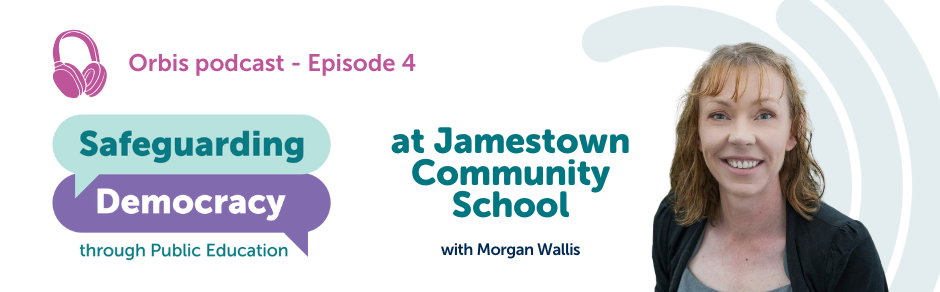
Morgan Wallis - Teacher, Jamestown Community School
In this episode Morgan Wallis from Jamestown Community School joins us to talk about the cycle of inquiry she led at her school as part of the Safeguarding Democracy through Public Education 7-8 program. Jamestown Community School had a focus on learner agency as their area of impact, and Morgan shares how attending the program supported her with strategies to engage her students and make civics and citizenship exciting.
Hear how she supported students to access multiple tiers of government, develop community connections and build ethical citizens to safeguard democracy!
LISTEN NOW
Transcript
Shane Heatlie: This podcast is produced on the traditional land of the Kaurna people. Orbis would like to acknowledge the traditional custodians of the land and pay respects to all elders, past and present. Hello and welcome to the Orbis Podcast. My name's Shane Heatlie from South Australia's Department for Education, and in this episode, we are talking with Morgan Wallis from Jamestown Community School on Ngadjuri and Nukunu country. Hello, Morgan. How are you?
Morgan Wallis: Hello! I'm very well, thank you.
Shane Heatlie: Thank you so much for coming to talk to us about your experience with the Safeguarding Democracy through Public Education. Now, you were in the 7 to 8 program. Is that correct?
Morgan Wallis: Yes, I was.
Shane Heatlie: So tell me what really, well, let's start off. Tell us a little bit about Jamestown Community School (JCS). Where abouts are you? Just for those listeners who might not know.
Morgan Wallis: So, we're about 3 hours north of Adelaide. We're an R-12 site with about 250 students across reception to year 12.
Shane Heatlie: Okay. What years do you teach?
Morgan Wallis: I currently teach year 5 - 6 HASS, year 7 and 10 English and year 7 History.
Shane Heatlie: So, learning about democracy with your students, you know, sometimes people and staff and teachers can be a little bit, you know, put off by that and they feel like they don't quite have the knowledge set that's required. So what excites you about teaching and learning democracy with students?
Morgan Wallis: I think the fact that democracy is everybody's business, it is something that we tend to put to the side because it is one of those harder subjects to teach. It's the one that we end up teaching last. So being able to get our students excited about, democracy in the democratic processes is something that is really exciting for me. It's about informing kids on how to become really good citizens and be able to give back to our community. We have really strong ties with our community here, being a community school, so being able to upskill our students in those areas, it allows us to continue to build that really good connection with our community.
Shane Heatlie: And I can see, and I've read that you've been quite proactive in promoting the civics and citizenship at the school with a number of, different initiatives have been set aside or put into practice, sorry.
Morgan Wallis: Absolutely. We were really lucky this year that we had the Governor of South Australia visit our site, and the students were able to see that process around the importance of the Honourable Frances Adamson within our structure and the importance that she has in that role, from the parliamentary side of things. We have our democratic processes through voting for our student leaders and the process through that. We have really been really lucky in students winning the Anzac Spirit Prize. We've had 2 students last year and 1 student be successful this year.
We had a student submit an entry into the Eden School Prize and was recognised in, a merit within that award as well. So, we’re certainly building the profile within our school with these civics and citizenship connections and awards, and it really shows the students that their choices and their views around inclusivity are really valued and important, and to be able to have that connection is really strong here as well.
Shane Heatlie: That's awesome. And I suppose there's a lot of schools and sites out there that would be doing similar things and think, so why would I need to go and do some professional learning around democracy?
Morgan Wallis: I think it's an area where we tend to not focus on so much, and I think that's because we just don't have the skillset and the confidence to be able to teach this effectively. Going away and doing this safeguarding democracy training really allowed me to build my own skillset and to be able to engage students within the classroom in a different way. Being able to really unpack their thoughts and how they are able to contribute to our society.
There were some strategies that I hooked into and were really able to see that it would improve their outcomes in their understanding of democracy within the classroom. So being able to upskill myself and then come and upskill the team of HASS teachers, within JCS, it really strengthens our own abilities and our own knowledge to be able to teach this effectively, to build better citizens.
Shane Heatlie: And a part of that program was looking at a cycle of inquiry. Can you tell us a little bit more about that and maybe what inspired yours? I, I didn't read that, one of your questions was, should our Constitution be changed to allow 16-year-old citizens to vote? I'm sure there'd be some pretty interesting responses to that.
Morgan Wallis: Yeah, there certainly were. So, mine came about. I was I had the year 5/6’s and we were watching an episode of BTN where the UK had changed their voting age to 16, and it sparked a really interesting conversation within our students around whether or not we would follow suit in that with our system being very similar in the structure. And so, we started to unpack that and, JCS’s area of impact is that learner agency. So, this really excited them around having that voice within their learning. And so, we unpacked that around what would have to happen for 16-year-olds to be able to vote. What the implications, the advantages and disadvantages on that. So, students went off and created some surveys, went and surveyed a whole heap of people from around Australia as we spoke about how this would be an Australian change rather than a local change, and some of the findings were really interesting. One student interviewed a grandparent, and their choice, or their view was that the voting age should actually increase to 20 because they didn't believe that 18-year-olds had the knowledge to be able to make good choices about the future of Australia. So it was really interesting to see those responses and getting the students perspectives on, well we're talking about it decreasing to 16, should we actually be talking about it increasing to 20? So it was quite a good little inquiry study for students to see the different perspectives and how they are the future of those voices and their, citizenship really needs to come into practice and play with their choices.
Shane Heatlie: Did the students have any interaction with, like local council level of government or up into state or federal?
Morgan Wallis: Yeah, we certainly did. So we engaged with all three of those and got people's perspectives around that. We wrote letters, so we spoke about the formality around engaging with the people at those 3 different levels, what it is that we were asking if we needed a response. So we actually brought in some literacy skills there too around writing formal letters, asking for responses, being able to give the evidence and the results that we had collated from our surveys to then be able to voice our perspectives, and what we would have seen as likely changes in the future.
Shane Heatlie: Yeah, and we there's as a part of the program, there's the showcase of practice now that came out regionally to you, but we've seen, similar sort of event here in Hindmarsh, in Adelaide. And one of the things that, I noticed just talking with teachers and sites, was that, you know, usually you think around democracy and civics and citizenship really sitting within the HASS discipline, but it's actually quite cross-curricular like you've just pointed out with that writing of letters.
Morgan Wallis: Absolutely. And this certainly evolved into something that was bigger than I ever anticipated in that cross-curricular. So students, we made graphs, we plotted data. We talked about whether or not one result, needed to be included with the 20-year-old, with the woman saying that we should have a 20-year-old age rather than 18. So we spoke about outliers within maths and whether or not they should be included in our data sets, or if we completely ignore them as a bit of an outlier. We spoke about, formal writing and the way that we structure a formal letter and how we structure that with the vocabulary choices. So it became very much rather than a HASS dominated project, it was very cross-curricular dominated, and it allowed student’s skill sets to be brought in. So for the students who didn't love the HASS subject and are really strong in being able to unpack data sets, they were being really successful in this project as well. So it really allowed students to engage across all fields.
Shane Heatlie: Yeah, that is awesome. So, and that's one of the stories that we're hearing as well, the impact on student learning has gone broader than just the discipline of HASS. Is that your experience as well?
Morgan Wallis: Oh, absolutely. The students were able to then showcase their own skills. I have one boy who just did not want to engage in this, and by the end of it, because he is very maths dominated, he was showing his skills in that, and so I was able to then engage him and show his ability to be successful through maths in a HASS subject.
Shane Heatlie: That is absolutely gold. Well, how did you engage other people in the school with this work?
Morgan Wallis: So because we're R-12, we were able to see that the other subjects areas could then gravitate towards this, they were using the data sets, they were using some of the conversations our students were having, then we were able to showcase this to our principal, and we could see that, like she read the letters that we were able to send off to different people, and it allowed then for me to bring those skill sets back from this training to then upskill our R-12 team.
Shane Heatlie: And that's, something that's wonderful with professional learning, it can start with just one person, and then there's a contagion effect that then can spread throughout, you know, like a learning team or a school or even in this case, probably of the broader community, if you've been liaising with, local council.
Morgan Wallis: Absolutely, yes. And with even the surveys that the students were going to conduct, they were going and speaking with their next-door neighbour, and they were going and talking with their grandparents, and it allowed those conversations to really engage people verbally as well. So, it got people out and about and it got our students going and visiting their next-door neighbour or calling an aunty or uncle they may not have spoken to for a little while, to have this conversation around,”Well what are your views? Do you think the voting age needs to be decreased to 16?” And our other question was whether or not councils should make elections, for their councillors compulsory? And so it got our local Northern Area Council residents engaging in those conversations around, actually, I should vote for people within council or I should have that compulsory voting, within our council area so people's voices are heard. And the students were pretty blown away by the fact that council elections are voluntary. They don't have to go and vote within that, and it really got them thinking about the impact, a minority who choose to vote, have over the majority of people within our council area. So it really was quite authentic and interesting conversations that came because of this inquiry study.
Shane Heatlie: So, if there's other teachers out there that are thinking about, ‘Mmmm, maybe I can see this translating into my site’ what would your words of advice be?
Morgan Wallis: Just have a go. Because how this really came to fruition, we weren't starting with this inquiry topic. I had sort of had visions of going down a different line of inquiry with, the 5/6s, but they ran with this. They picked it up and went, actually, we want to know about this. So just give it a go, because where we ended up landing was incredible. The connections with other subjects, with the connections with other teachers, the connection to community, happened because we were just having a go at something that was different.
Shane Heatlie: Yeah, that is absolutely fabulous to hear and I know there's a lot of people who would be very happy to hear that as well. So, for those people out there, if you are interested in enrolling in Safeguarding Democracy in 2026, enrolments are now open. There's a years 7 to 8 for HASS teachers, but like you can just hear from Morgan's experience, she dropped that down to year 5 and 6, so it doesn't necessarily, live within that, that year band at all. And there's also another program for more specialised for 9 to 10, but non-HASS teachers and that is more around that cross-curricular nature of that.
So where to now, where to now for Jamestown Community School and the work for the cycle of inquiry that you've been, running there? What can you see happening from here?
Morgan Wallis: Well the great thing about this cycle of inquiry, it can be tailored to any subject area. The process that we went through was about a HASS topic. We did civics and citizenship, but any inquiry question can be posed in any subject area. And the cross-curricular opportunities within that are just so rich that you can bring in your English speciality teacher to do something within this field, or you can bring your maths teacher in to analyse different data sets for the end result to be, answering that inquiry, question, but it allows for a team approach to happen. So I'd like to see JCS in 2026 to continue to pose questions within our classes, get the students to pose those questions and go through that process of engaging with the community, having those cross curricular subjects, coming in and engaging in more than one teacher within that classroom so students can see that a particular project incorporates so many different skill sets.
Shane Heatlie: Oh, look, it's almost like, civics and citizenship by stealth isn't?
Morgan Wallis: Oh, absolutely it sure is. This certainly has for me as a professional, like I've been teaching for 15 or 16 years, and this is one of the best PD that I've ever been engaged with, because it's not extra, it sits alongside what we're already doing, and it just makes us more aware and a bit more, in tune with what we're actually facilitating in the classroom. Like, I would have taught 5 and 6 civics, but I wouldn't have done it as effectively had I not done this safeguarding. I'm more than happy to shout the amazingness that is this program from the rooftops, because you guys have done an incredible job at really putting things in place to be able to safeguard democracy in the future, so be interesting to see the data set in 10 years' time to see whether or not that, that trust within democratic processes has improved. I look forward to that because I'm a bit of a data geek, so I'll keep an eye on that one in 10 years and see if it actually has an improvement.
Shane Heatlie: That is a lovely thing for you to say. Well, Morgan, it has been an absolute pleasure, talking with you today. Thank you very much for taking your time to join us here on our Orbis podcast. Congratulations on a great piece of work, and look, the students and your school and the community are definitely going to benefit from your work and taking those risks.
Morgan Wallis: Absolutely, and that's the first step is just taking that risk and seeing where it lands.
Shane Heatlie: Thanks a lot for joining us.
Morgan Wallis: You're welcome.
Shane Heatlie: See you later.